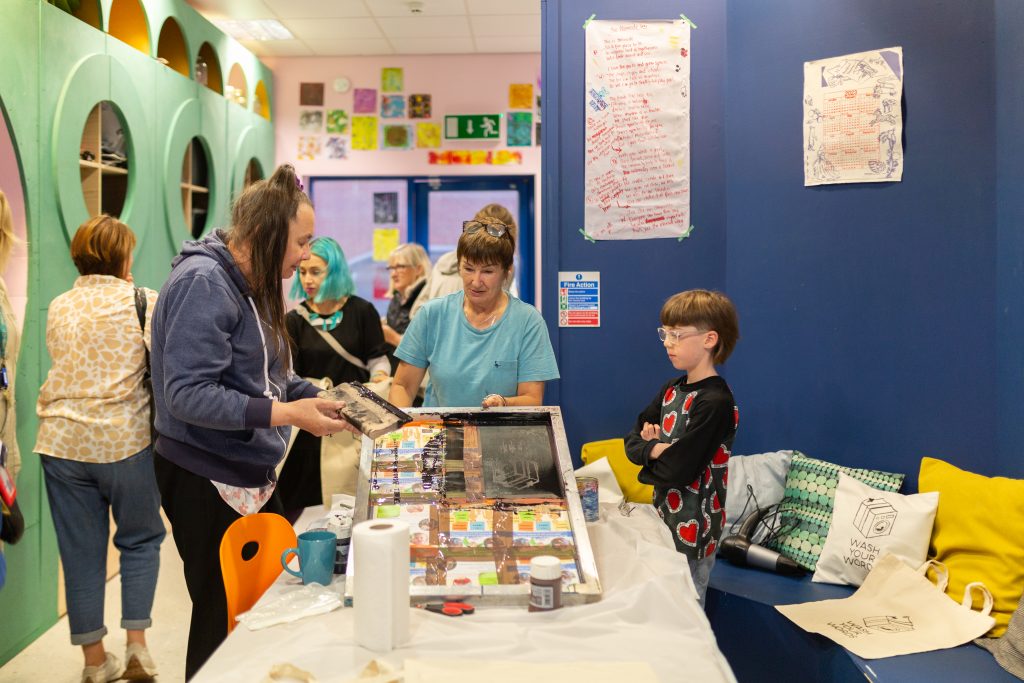
At CREATIF, we believe that great design happens when everyone has a seat at the table. Design is at its best when it’s not a top-down process but a shared one. For Wash Your Words, we worked shoulder to shoulder with members of the Blackpool community from day one, using a Human-Centered Design approach to guide us.
Rather than starting with fixed ideas or polished concepts, we began with open conversations. We asked questions, listened, and invited people to bring their perspectives, lived experiences, and aspirations into the process. Every decision—from the name of the project to the final logo—was shaped by the people who would ultimately use and care for the space.
This wasn’t about being a “designer” with the best idea in the room. It was about combining different voices and seeing what emerged together.
To do that, we used simple but powerful tools: sketching, group brainstorming, and rapid prototyping. We laid out paper, pens, and scraps, and encouraged participants to cut, collage, and reimagine ideas. People combined elements in playful ways—books on a washing line, bubbles drifting through book pages, even eyes inside washing machines. The more ideas, the better. The goal wasn’t perfection; it was exploration.
The name generation was one of the liveliest parts of the process. Because this was an idea born in Blackpool, the group naturally brought in lots of fun and cheeky suggestions. We played with the unlikely combination of a laundry and library in one space, which gave the naming process a unique twist. Some of the favourites along the way included:
- Soap’s & Dreams
- Read & White’s
- Wash & Learn
- Dirty Words
- Filthy Book Club
- Machine Learning
- Read Between the Lines
- And the no-nonsense suggestion: It Is What It Is
In the end, the group landed on Wash Your Words—a name that felt playful, local, and full of personality.
From there, we shifted into visuals. We started sketching out ideas: laundry machines, books, bubbles, community symbols, lines of washing. One concept caught the group’s attention—a washing machine hidden among the spines of a row of books. It was unexpected, clever, and simple enough to build on. Through a series of scrappy sketches and group feedback, we collectively arrived at a concept everyone was excited to refine.
By the end of the co-creation process, the community felt true ownership over the identity. The final outcome wasn’t just a logo or a name—it was a story of collaboration, creativity, and local pride. When people saw the final brand, they didn’t just recognise it; they recognised themselves in it.